Set between Bangkok’s urban pulse and the relaxed coastline of Pattaya, Amata Spring Country Club stands as one of Thailand’s most technically intriguing and visually striking championship venues. Since opening in 2005, the course has built a reputation that aligns with elite tournament golf while offering a distinctive architectural identity rarely seen in the region.
 A Proven Championship Stage
Amata Spring’s credentials are firmly established. The venue hosted The Royal Trophy from 2006 to 2010, where Europe secured three victories against Asia in a competitive eight-man team format. It also staged the inaugural Honda LPGA Thailand in 2006 and later welcomed the Thailand Golf Championship in 2011, where Lee Westwood claimed a milestone victory.
This pedigree reflects a course built for high-level competition one that rewards precision, demands strategy, and consistently challenges elite players.
Layout and Design Philosophy
From the first tee, the course presents a modern championship layout defined by long, undulating fairways, well-guarded greens, and strategic water placement. The routing flows seamlessly around two expansive lakes, creating both aesthetic appeal and constant tactical pressure.
The greens are quick and true, complemented by intelligent bunkering that frames approach shots without overwhelming the visual landscape. Every hole feels deliberate. Nothing is incidental.
Architect Lee Schmidt and his team worked with a site originally shaped by industrial planning. A large excavation lake, once intended as a water source became the foundation of the course’s identity. Through thoughtful re-engineering, the land was transformed into a cohesive layout where water is not an obstacle but a defining feature.
The Signature: A Floating Green
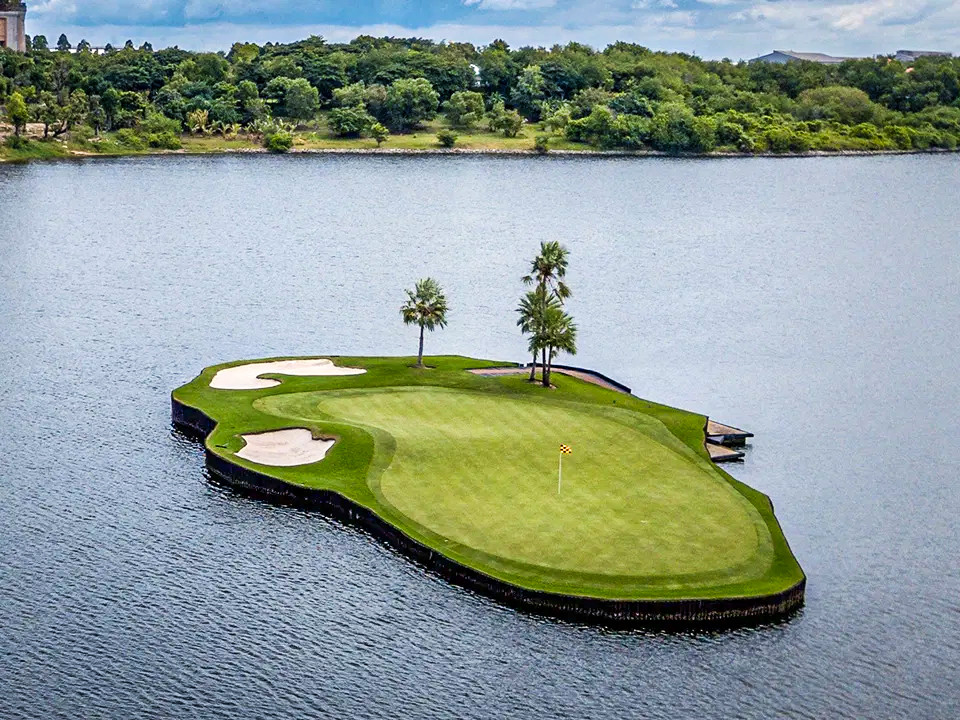
Amata Spring’s most talked-about feature is the par-3 17th hole, a concept that redefines what a signature hole can be.
Unlike traditional island greens, this putting surface floats on water. Measuring nominally 145 yards, the yardage itself becomes secondary. The green can be repositioned, altering the effective carry distance depending on setup.
Access to the green is equally memorable. Players board a small ferry, guided by trained staff, to reach the surface. The experience is precise, controlled, and entirely unique in championship golf.
From a playing perspective, the hole demands full commitment. There is no bailout, no margin. It is a moment of focus one that stays with the player long after the round.
Key Holes That Define the Round
While the 17th draws global attention, several other holes contribute significantly to the course’s character:
- Hole 4 (Par 4): A long and demanding test, guarded by a creek in front of the green. The backdrop of a traditional Thai temple adds a cultural dimension that elevates the visual experience.
- Hole 7 (Par 5): A downhill risk-reward opportunity with cross-bunkering that challenges decision-making on the second shot.
- Hole 8 (Par 3): A long carry over water to a multi-tiered green. Pin position dictates difficulty, making club selection critical.
- Hole 18 (Par 4): A strong finishing hole stretching beyond 470 yards. Water runs along the entire left side, while bunkers protect the right. It requires both length and accuracy to close effectively.
Each of these holes reinforces the course’s design philosophy, reward the disciplined golfer while exposing any lapse in execution.
Playing Experience
Amata Spring delivers a balanced experience. Off the tee, players are encouraged to shape shots and manage positioning rather than rely solely on distance. Approach play becomes the defining factor, particularly with elevated or tiered greens demanding precision.
The presence of water on multiple holes introduces a psychological element. It is not intrusive, but it is always relevant. Decision-making is constant. Shot commitment is essential.
Despite its championship difficulty, the course remains playable. Fairways are generous enough to allow recovery, yet strategic enough to punish complacency.
Amata Spring Country Club is not defined by a single feature, even one as iconic as the floating green. It is defined by execution in design, in conditioning, and in overall experience.