By Brig Gen Salim Akhtar (Retd.)
I have seen amateurs decide to turn professional before their game was ready because they expected to start earning. The prize money is real, but so are the bills. A player can pay for the flight, hotel and caddie, miss the cut and go home without a cheque. The question I would ask first is this: how often can you play well when the course is unfamiliar and the week is not going your way?
Siddikur Rahman is a useful example for young Bangladeshi golfers. Before turning professional, he already had the experience of competing abroad as an amateur for Bangladesh. Those rounds gave him time to develop both his game and his ability to handle pressure. A player also needs the fitness to get through practice rounds and four days of competition without losing sharpness. Making the cut is only the first hurdle. Then there is the work of climbing the leaderboard.
Measure the game you can repeat
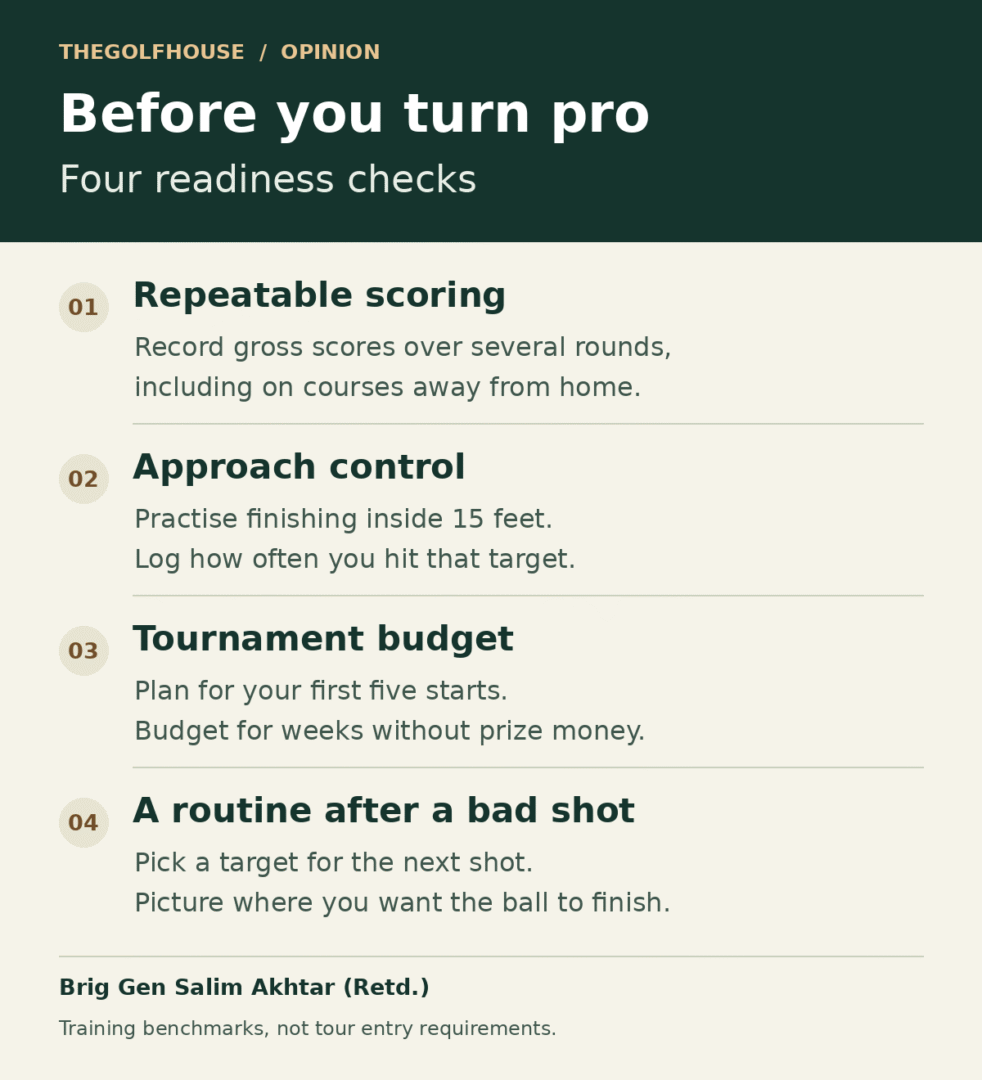
During a Bangladesh Golf Federation training programme at Kurmitola Golf Club in 2013, coach Ian Smith set some useful benchmarks: play to a plus-two handicap level, shoot two under par or better regularly at home, and practise hitting approaches inside 15 feet. The last one is easy to measure. Pick a target, hit a series of shots and record where they finish, not just where they land. A good round at home is encouraging. A run of good scores on different courses tells you much more.
I would track greens in regulation, fairways hit, approach proximity and putts over several rounds. Getting to around 12 greens in regulation is a useful practice target; 14 is a more demanding benchmark when testing readiness. I would also track whether putting is moving towards an average of 1.75 putts per hole, alongside the quality of the approach shots. These are training benchmarks, not tour entry requirements. And if a player’s Playing Handicap for an event is +2, a gross 70 becomes a net 72. That adjustment does not apply simply because the player’s Handicap Index is +2.
Build the budget before entering
A qualifying school, or Q-School, is one route to earning playing status on a tour. Entry conditions, stages and the number of cards awarded vary by tour and season. Check the current terms before booking a flight or paying an entry fee. For a Bangladeshi golfer, the Professional Golf Tour of India is a regional option worth assessing, but the cost depends on the actual venues and itinerary.
Allow for entry fees, visas, flights, accommodation, local transport, meals and caddie fees, including practice days. Build a budget from the published schedule. For a player paying their own way, I would plan an initial block of five tour starts rather than commit to a full season. Work out whether the budget can absorb two poor results at the start. Even a strong finish does not automatically cover the cost of the next trip; the purse and a player’s expenses vary.
Train for the next shot
On a 430-yard par four, a 300-yard drive along the line of play leaves roughly 130 yards. From there, many players have a shorter club in hand than they would after a 260-yard drive. But extra distance matters only if it leaves a playable shot. Track where drives finish and whether the approaches that follow leave realistic birdie chances. Use a launch monitor if one is available, but keep a simple record at the range or on the course if it is not.
Clubhead speed is only part of the picture. Smash factor is ball speed divided by clubhead speed: 140 mph of ball speed from a 100 mph swing gives 1.40. Centred contact can improve that ratio without a faster swing. Work with a coach on movement and strike quality, and use measured ball flight to guide equipment choices. The same swing angles, shaft or spin target will not suit every golfer.
Practise what happens after a bad shot
The shot that matters after a bogey is the next one. Before stepping up to the ball, stand behind it, pick a landing spot and picture how the ball will get there. Rehearse that routine on the range and on the course. Before a tournament, you can also sit somewhere quiet and play the holes in your mind, including the hazards you noticed in practice. I saw mental training introduced at the Bangladesh Golf Academy and later at Kurmitola. What we failed to build was a daily habit after the sessions ended.
Before you turn professional, put three things on the table: your recent gross scores on several courses, a record of where you are losing shots, and a budget that can withstand missed cuts. If one is missing, you know what to work on before paying for the next qualifier.
Brig Gen Salim Akhtar (Retd.) worked with the Bangladesh Golf Federation on golf development from 2009 to 2016. He was the first rector of the Bangladesh Golf Academy and a founding vice-president of the Bangladesh Professional Golfers Association.